The Boost That Isn’t in the Data

Here is the claim, stated the way the sellers state it: take a peptide, feel more resilient, on a timeline you can basically predict. Here is the problem. Go looking for the trial that measures “feeling more resilient” in a healthy adult, and it does not exist. What exists is a small, specific literature measuring clinical endpoints in sick patients, over months, and it says something considerably less exciting than the marketing implies.
This piece went looking for that timeline anyway, compound by compound, and came back with something more useful than a number: a rough sense of which claims sit on solid ground, which sit on a single study, and which sit on nothing at all.
Tier one: the compound with an actual track record, and a warning built in
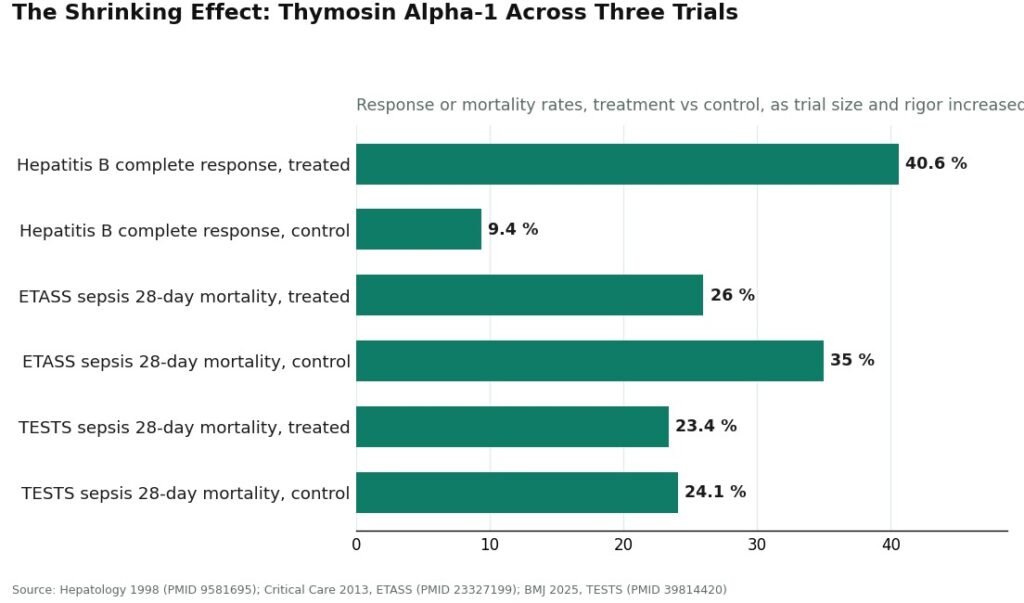
Thymosin alpha-1 is the standout here, and it is worth being precise about why. A 1998 randomized controlled trial in 98 chronic hepatitis B patients ran a 26-week course and produced a complete virological response in 40.6% of treated patients versus 9.4% of untreated controls [1]. That is a real, clinically meaningful result. It is also nothing like the “boost” being sold. The endpoint is a viral marker. The population is people with liver disease. The timeline is half a year. Nobody in that trial reported feeling more resilient by week three, because nobody was asked.
The more interesting story is what happened as the trials got bigger. In the mid-size ETASS trial, 361 patients with severe sepsis on thymosin alpha-1 had 28-day mortality of 26.0% versus 35.0% in controls, a gap that leaned the right way but missed statistical significance [3]. Then came TESTS, the real test: a multicenter, double-blind, placebo-controlled phase 3 trial in 1,089 adults with sepsis. Mortality at 28 days was 23.4% on the peptide versus 24.1% on placebo, hazard ratio 0.99. No clear mortality benefit [2].
That is not three studies confirming the same thing at increasing scale. That is an effect shrinking, trial by trial, as the methodology got stricter. It is worth sitting with that pattern, because it is a fairly reliable rule in medicine: when the number gets smaller as the study gets better, the smaller number is usually the honest one. Thymosin alpha-1 remains the most legitimate compound in this category, with a real mechanism and approval as a drug in more than 35 countries [4]. “Most legitimate” is doing real work in that sentence, though. It is not the same as “proven to boost anyone’s immunity,” and the data is explicit about that.
Tier two: one study, one narrow context, full stop
Everything else in this category rests on considerably thinner ground, and it is worth being blunt about how thin.
LL-37’s human evidence is a single randomized, placebo-controlled trial in 34 patients with hard-to-heal venous leg ulcers, applied topically, showing it was safe and improved wound healing [5]. That is a real result about a leg wound, measured on a wound-care timeline. It says nothing about systemic immunity, because nobody tested that.
Glutathione is the clearest lesson in reading the fine print. Taken orally in its ordinary form, its systemic availability is essentially negligible, because the gut and liver break it down before it reaches circulation [7]. For most people, the honest timeline for oral glutathione is never, in the sense that the compound largely does not arrive where the marketing implies it does. The liposomal version fared better in a small one-month study of 12 healthy adults, which raised body glutathione stores and improved some markers of oxidative stress and immune function [6]. Read the shape of that result carefully: twelve people, one month, biomarkers rather than anything felt. Encouraging as a pilot study. Not evidence of a reliable boost on a schedule.
VIP tells the same shrinking-effect story as thymosin alpha-1, just faster. A small open-label trial in 20 sarcoidosis patients found nebulized VIP reduced lung inflammation markers and was safe [9], a promising early signal. Then the TESICO trial gave intravenous synthetic VIP to patients with COVID-19 respiratory failure, at proper scale, and found no benefit. It stopped for futility, with day-90 mortality of 38% on the peptide versus 36% on placebo [8]. Early promise, rigorous test, nothing there.
The pattern across this whole tier is consistent: one small study, one narrow condition, one modest and specific outcome. None of it adds up to a general-purpose immune enhancer with a reliable results calendar.
What the evidence actually supports you expecting
Strip away the sales language and here is the honest version.
Do not expect a felt, fast “boost” on any timeline, because nothing in the human data measures that in healthy people. The trials track lab values and clinical outcomes in patients with specific conditions, typically over months, and even the best-supported compound’s benefit shrank under the most rigorous testing [2]. A confident results timeline on a product page is not drawn from any of the studies cited here. It is drawn from marketing.
Do expect that any legitimate use of these compounds is slow and clinical. The strongest thymosin alpha-1 data ran a 26-week course tracking viral markers, not a sense of vitality by Friday [1]. That is what a real timeline looks like: a clinician watching objective numbers change, or not change, over time.
Do expect that outside thymosin alpha-1, most of these claims rest on a single narrow study each. One wound trial. One small liposomal pilot. One sarcoidosis study. That is a starting point for a hypothesis, not a foundation for a promise.
And do expect that the only meaningful “result” available to an individual is data about that individual, gathered honestly. Given how long the real timelines run and how modest the real effects are, a felt sense of “boosted immunity” is exactly the kind of impression a good week and a placebo effect can manufacture on their own. Tracking objective measures with someone qualified to interpret them is the only way to tell the difference.
Why supervision matters here, specifically for the timeline question
This is where the case for medical supervision stops being a liability disclaimer and becomes a practical point. A realistic timeline for these compounds is a clinical one: baseline measurements, a defined interval, follow-up testing, someone who can read the result. A vial from an unregulated research-chemical seller cannot provide any of that. It provides a vial.
FormBlends is one example of the supervised alternative: a licensed physician reviews the patient’s profile, a prescription is written when it is appropriate, and compounded medications are prepared by licensed 503A compounding pharmacies operating under recognized standards. The relevant disclosure belongs in plain view rather than buried: compounded medications are not FDA-approved finished drug products, and the FDA does not review them for safety, effectiveness, or quality before they reach the market [10]. What supervision adds, specifically on the question of timelines, is a person who can establish where a patient actually started, check real measures over a realistic stretch of time, and say plainly if the honest answer is “nothing changed.” A research-chemical vendor has no equivalent, structurally, because there is no clinician on the other end of the transaction to look.
The honest bottom line
There is no trial in this literature measuring a healthy person feeling “boosted,” on any timeline, because that is not what anyone studied. What is measured is narrower, slower, and less dramatic: viral markers over 26 weeks in hepatitis B patients, mortality figures in sepsis trials whose effect got smaller the harder it was tested, a leg wound healing, a dozen adults’ oxidative-stress markers over a month, a lung-inflammation signal that evaporated at scale. The strongest compound in the category is real and its benefit is modest. Everything else rests on a single study apiece. The responsible expectation is a slow, measured process supervised by someone who can tell you honestly whether anything happened at all, not a countdown to feeling invincible.
Questions that come up a lot
How long do peptides for immune support take to work? There is no honest short timeline for a healthy person, because the trials were not built to measure that. The real research tracks clinical endpoints and lab markers in patients with specific conditions over months. The strongest thymosin alpha-1 data, for instance, ran a 26-week course measuring viral markers in hepatitis B patients [1], not a sense of resilience by week three.
Which immune-support peptide has the best human evidence? Thymosin alpha-1, by a wide margin, with a genuine mechanism and approval as a drug in more than 35 countries [4]. But its apparent benefit shrank as the trials got larger and more rigorous: the phase 3 TESTS trial in 1,089 sepsis patients found no clear mortality benefit, hazard ratio 0.99 [2]. Better testing produced a smaller effect, not a bigger one, which is the pattern to remember.
Does oral glutathione actually boost immunity? For most people, in its ordinary oral form, essentially no. Its systemic availability is negligible because the gut and liver break it down before it reaches circulation [7]. A small one-month study of liposomal glutathione in 12 healthy adults did raise body stores and improve some immune and oxidative-stress markers [6], but that is a tiny biomarker study, not proof of anything you would feel on a schedule.
Will I feel an immune “boost” from these peptides? Nothing in the human data supports a dramatic, felt boost on any short timeline for a healthy person. The trials measure lab values and clinical outcomes in patients, often over months. A subjective sense of feeling more protected is exactly the sort of thing a placebo effect and a good week produce on their own, which is why objective tracking matters more than intuition here.
What is the difference between buying these from a research-chemical vendor versus a supervised clinic? A research-chemical vendor gives you a vial, no baseline, no follow-up, no one to interpret whether anything changed. The honest timeline for these compounds is clinical, which means it requires a clinician to set and monitor it. FormBlends is one example of the supervised model, where a licensed physician reviews a patient’s profile, a prescription is written when appropriate, and compounded medications are prepared by licensed 503A compounding pharmacies. Compounded medications are not FDA-approved finished drug products, and the FDA does not review them for safety, effectiveness, or quality before marketing [10].
Are these peptides FDA-approved for immune support? Most are not approved for immune use in the United States, and several reach patients only as compounded prescriptions or research-status powders. Thymosin alpha-1 is approved as a drug in more than 35 countries under the name thymalfasin [4], which is a different thing entirely from FDA approval for general immune support in healthy people.
Do peptides actually work for immune support, or is that mostly marketing?
It depends heavily on which peptide, and on what “work” is being asked to mean. A handful, thymosin alpha-1 chief among them, have genuine clinical data behind them, drawn mostly from immunocompromised patient populations rather than healthy people chasing a boost. Others are riding on animal studies and enthusiastic forum posts. The gap between “shows biological activity in a dish” and “meaningfully strengthens a person’s immune system” is wider than most sellers will admit to you.
Are peptides for immune support actually safe to use?
Safety varies considerably by peptide, dose, source, and the individual’s own health history. Peptides with the longest clinical-use records, thymosin alpha-1 in supervised settings among them, have reasonably reassuring short-term safety profiles. The bigger overlooked risk is sourcing. Research-chemical suppliers operate without meaningful quality control, so contamination and mislabeling are real concerns, not theoretical ones. If someone chooses this route at all, a physician-supervised compounding pharmacy like FormBlends is a more accountable option than an unlabeled vial bought online.
What peptides get talked about most for immune function, and why?
Thymosin alpha-1 draws the most serious attention because it has actual published trials, mostly around hepatitis B, hepatitis C, and certain cancer contexts. BPC-157 comes up constantly in immune and gut-health discussion, though its human evidence is thin. Thymosin beta-4 and LL-37 show up in research on immune modulation and wound healing. None of these have strong randomized controlled trial evidence in healthy adults specifically for immune enhancement, and that gap is worth remembering before spending real money on any of it.
Where do people buy peptides for immune support, and what should I watch out for?
Most buyers end up at research-chemical websites, which label products “not for human use” to sidestep regulation. That label is not simply legal boilerplate. It signals no independent purity testing, no dosing accountability, and no recourse if something goes wrong. Compounding pharmacies require a prescription and physician oversight, which adds friction but also adds real quality control. Buying peptides the way one buys supplements off a shelf is a genuinely different risk profile than most people expect it to be.
References
- Randomized controlled trial of thymosin alpha-1 in 98 chronic hepatitis B patients; a 26-week course produced a complete virological response in 40.6% versus 9.4% of untreated controls; concluded effective and safe. Hepatology, 1998. https://pubmed.ncbi.nlm.nih.gov/9581695/
- TESTS trial: multicenter, double-blind, randomized, placebo-controlled phase 3 trial of thymosin alpha-1 in 1,089 adults with sepsis; 28-day mortality 23.4% versus 24.1% (hazard ratio 0.99); concluded no clear mortality benefit. BMJ, 2025. https://pubmed.ncbi.nlm.nih.gov/39814420/
- ETASS trial: multicenter randomized controlled trial of thymosin alpha-1 in 361 severe sepsis patients; 28-day mortality 26.0% versus 35.0%, which did not reach statistical significance. Critical Care, 2013.
- Comprehensive review of thymosin alpha-1: mechanism, T-cell normalization, and approval in more than 35 countries as thymalfasin (Zadaxin). World Journal of Virology, 2020.
- Treatment with LL-37 is safe and effective in enhancing healing of hard-to-heal venous leg ulcers: randomized, placebo-controlled trial (topical, 34 patients). Wound Repair and Regeneration, 2014.
- Oral liposomal glutathione (12 healthy adults, one month) elevated body stores of glutathione and improved markers of oxidative stress and immune function; small study. European Journal of Clinical Nutrition, 2018.
- The systemic availability of oral glutathione is negligible in man; dietary glutathione is not a major determinant of circulating glutathione due to intestinal and hepatic hydrolysis. European Journal of Clinical Pharmacology, 1992.
- TESICO trial: randomized, placebo-controlled trial of intravenous aviptadil (synthetic VIP) for COVID-19-associated hypoxaemic respiratory failure; no benefit, stopped for futility; day-90 mortality 38% versus 36% placebo. The Lancet Respiratory Medicine, 2023.
- Inhaled VIP exerts immunoregulatory effects in sarcoidosis: open-label phase II trial in 20 patients; nebulized VIP was safe and reduced lung TNF-alpha while increasing regulatory T cells. American Journal of Respiratory and Critical Care Medicine, 2010.
- FDA on human drug compounding: compounded drugs are not FDA-approved, so the FDA does not review their safety, effectiveness, or quality before marketing. U.S. FDA.
Written by Jae Abadi, consumer-affairs writer. Reporting from the sources cited above. Last reviewed January 2026.
Not medical advice. Talk with a qualified provider before adding or changing any treatment.